
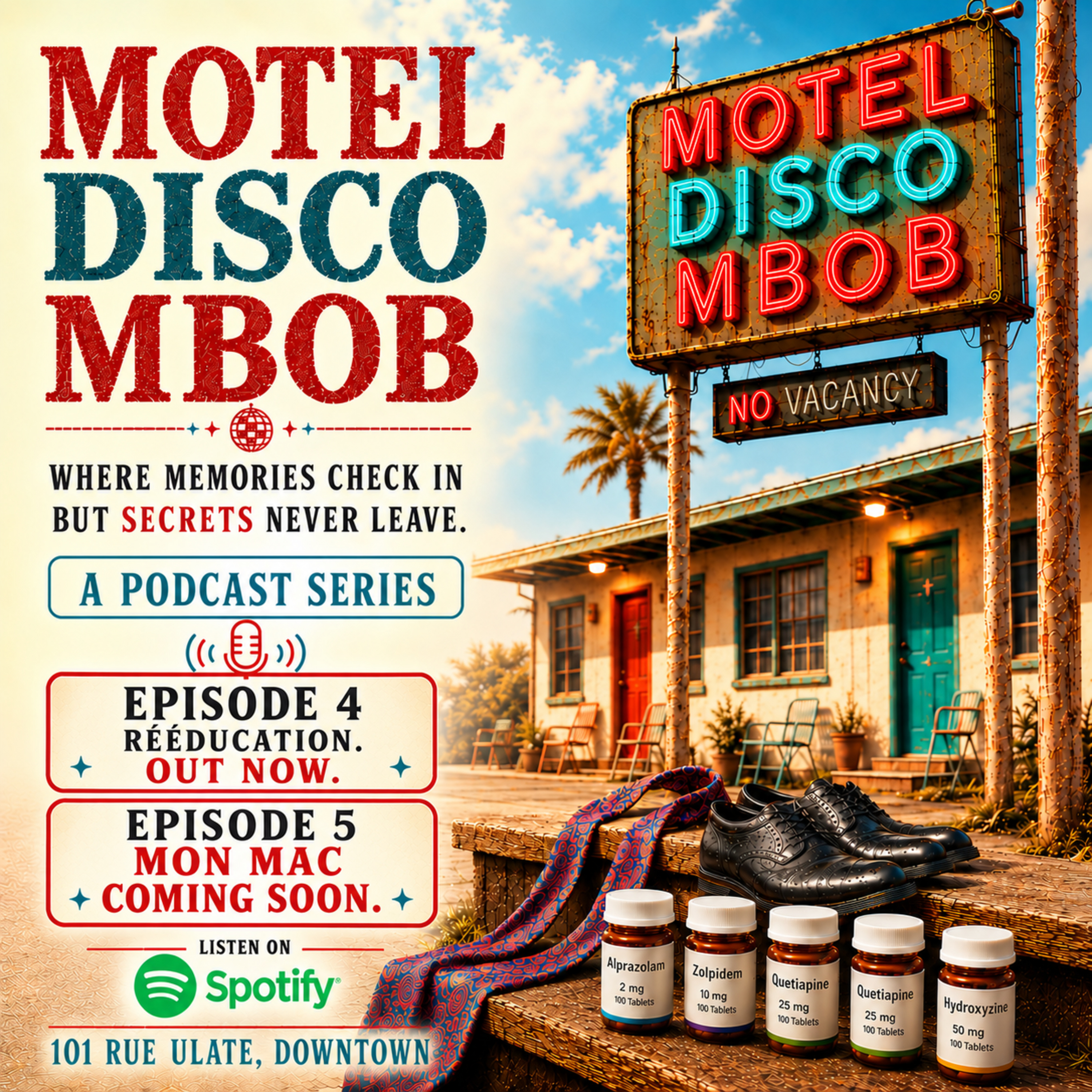
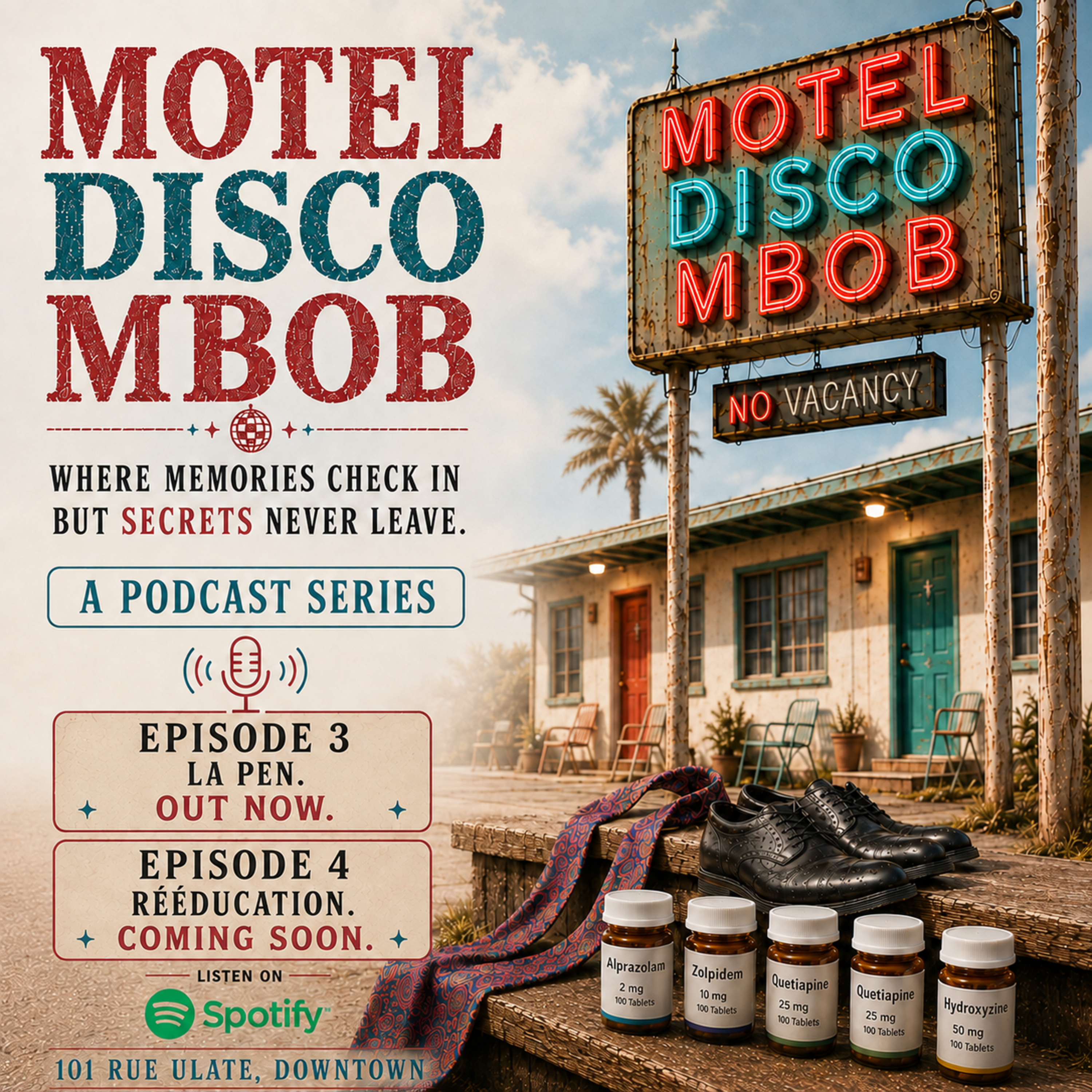
MS Rebels - Le mac, l'eau et le vin. Motel Disco Mbob A psychological fiction podcast.
Episode 5 – My Pimp, the Water and the Wine
What happens when the thing you use to escape your mind becomes the thing that owns it?
In this raw, darkly comic and deeply unsettling episode, we enter the fractured inner world of a man living with a degenerative disease, navigating the consequences of MS, questions around autism, isolation, addiction, alcoholism and a mind that can no longer be relied upon to remain quiet.
He wakes after another restless night. His mouth is dry, his body hurts, his head feels strange, and the memories of the previous evening slowly begin to return. Alongside the physical consequences of drinking comes something heavier: shame, self-hatred and disgust. The familiar realisation that once again, alcohol has won.
For him, drinking isn't about taste. It's about effect.
“One is too many and ten are not enough.”
The episode explores addiction not as an abstract concept, but as an intimate relationship between a person and the substance that has gradually taken control. There is no easy recovery narrative here. He knows he needs help. He has considered alcohol support groups. Yet the idea of a life without alcohol is almost impossible for him to imagine. The drink has become intertwined with his identity, his memories, his emotions and even his sense of creativity.
Against this background sits the reality of degenerative disease and MS — a body and brain that impose limitations on a life that once had purpose. Work has become impossible. Movement is difficult. Thoughts can become chaotic. The loss of independence creates an enormous amount of empty time, and in that emptiness the bottle becomes increasingly attractive.
The episode also touches on autism and the difficulty of navigating a world built around conversation, social interaction and expectations that don't always make sense to him. Solitude feels safer. Drinking alone becomes a ritual in which nobody appears to judge him and emotion can be opened or closed like a door.
But where does neurological difference end and mental breakdown begin?
These are difficult questions, and the episode doesn't pretend to provide tidy answers.
Instead, it moves between painful honesty and bizarre, observational humour. A stranger on a bus becomes the focus of an obsessive investigation. A woman sitting alone in a bar with a book and two small drinks becomes an enduring mystery. Memories of drinking in Stornoway, student nights, reckless experiments and lonely encounters reveal just how deeply alcohol has threaded itself through the narrator's life.
And then comes mindfulness — or something remarkably close to it.
During a memory of a birthday celebration beside the River Ouse in York, the narrator sits alone beneath a tree and begins experimenting with a bottle of wine, eight candles and eight crab apples. He lights the candles, places the apples into the flowing river and watches what happens.
He expects them to follow one another.
They don't.
The river carries them along different paths. Some drift away. Some become trapped. One candle goes out. Others follow unexpected currents.
And suddenly he sees something that changes the way he understands his alcoholism.
The river is the alcohol.
The candles are his thoughts.
Without the drink, he believes, his thoughts follow familiar and predictable paths. Thoughts become spontaneous, random and unpredictable. They leave the expected route.
For perhaps the first time, he understands why he drinks.
It isn't a cure. It isn't recovery. It doesn't make the addiction disappear.
But it is an insight.
There is humour here, but it is uncomfortable humour.
There is despair, but also curiosity.
There is addiction, but also an attempt to understand it.
And beneath everything is one persistent question:
If alcohol changes the way you think, feel and experience the world, are you drinking to escape your reality — or to finally experience a version of it that makes sense to you?
 Apple Podcasts
 Castbox
 Castro
 Goodpods
 Moon FM
 Overcast
 Pocket Casts
 Podbean
 Podcast Addict
 Podcast Republic
 Spotify